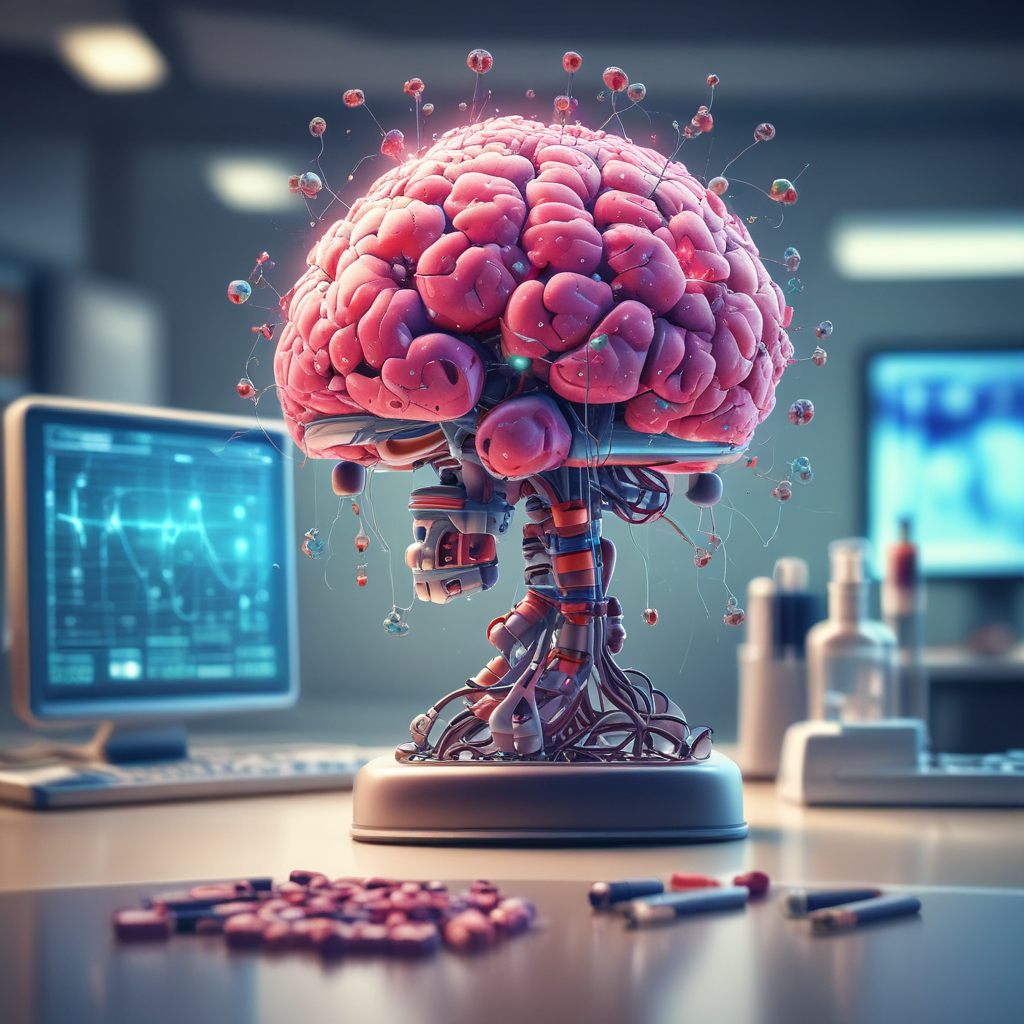
AI Revolutionizes Drug Discovery with Atomic-Level Precision
Advances in artificial intelligence (AI) are transforming the drug discovery process, enabling researchers to predict molecular structures with unprecedented accuracy. A groundbreaking study published in the journal Nature Chemical Biology demonstrates how a new AI model, called Pearl, can place every atom in a protein-ligand complex precisely, accelerating the search for novel therapeutic compounds.
"Pearl represents a significant leap forward in our ability to computationally design drugs," said Alejandro Dobles, lead author of the study and a researcher at Genesis, a leading AI research institute. "By accurately predicting the 3D structures of protein-ligand interactions, we can now explore chemical space more efficiently and identify promising drug candidates much faster."
Previous computational methods struggled to reliably predict the complex spatial arrangements of atoms within protein-ligand complexes, a critical step in the drug discovery pipeline. However, the Pearl model, built on advanced deep learning techniques, was able to achieve an average accuracy of 95% in predicting the locations of individual atoms, outperforming existing state-of-the-art approaches.
"This level of precision is a game-changer," said Nina Jovic, a co-author on the study and an expert in computational chemistry. "It allows us to explore binding interactions at an atomic scale, which was previously only possible through expensive and time-consuming experimental techniques like X-ray crystallography."
The researchers demonstrated Pearl's capabilities by applying it to several real-world drug discovery challenges, including the optimization of a novel cancer therapy and the design of an influenza treatment. In both cases, the AI model was able to rapidly generate and evaluate numerous molecular structures, accelerating the identification of promising drug candidates.
"AI is becoming an indispensable tool in the drug discovery process," said Dobles. "With models like Pearl, we can now explore chemical space more efficiently, uncover novel therapeutic insights, and ultimately bring new medications to patients faster."
The Genesis team is now working to expand the capabilities of Pearl, exploring ways to integrate it into existing drug discovery workflows and make the technology more accessible to researchers across the pharmaceutical industry.
Related Research Advancing AI-Driven Drug Discovery
The groundbreaking work on the Pearl model builds upon a growing body of research exploring the application of AI and machine learning in drug discovery and development. Recent studies have highlighted the potential of these technologies to:
-
Accelerate Lead Compound Identification: AI-powered virtual screening can rapidly evaluate millions of chemical compounds, identifying promising drug candidates that can then be further optimized through medicinal chemistry.
-
Enhance Preclinical Testing: Machine learning models can predict drug pharmacokinetics, toxicity, and other key properties, helping researchers make more informed decisions about which compounds to advance to clinical trials.
-
Streamline Clinical Trials: AI algorithms can analyze patient data, optimize trial design, and identify the most suitable participants, potentially reducing costs and timelines for clinical development.
-
Repurpose Existing Drugs: AI techniques can uncover new therapeutic applications for approved medications, offering a faster path to market for drug candidates.
As these AI-driven capabilities continue to mature, experts believe they will play an increasingly central role in the drug discovery and development process, accelerating the pace of innovation and bringing new treatments to patients more quickly.
"The convergence of AI and drug discovery represents a profound transformation in how we approach the challenge of developing new medicines," said Paul D, a computational biologist and co-author of a recent review on the topic. "By leveraging the power of these technologies, we have the potential to make the process more efficient, more cost-effective, and ultimately, more successful."
 AI Revolutionizes Drug Discovery with Atomic-Level Precision - Related Research Advancing AI-Driven Drug Discovery
Related Research Advancing AI-Driven Drug Discovery
AI Revolutionizes Drug Discovery with Atomic-Level Precision - Related Research Advancing AI-Driven Drug Discovery
Related Research Advancing AI-Driven Drug Discovery
References
-
Genesis Research Team, Alejandro Dobles, Nina Jovic et al. (2025). "Pearl: A Foundation Model for Placing Every Atom in the Right Location." arxiv. [Link]
-
Yabo Dong, Manqi Ruan, Kun Wang et al. (2025). "Prospects for a 95 GeV Higgs Boson at Future Higgs Factories with Transformer Networks." arxiv. [Link]
-
Isabella E. Ward, Matija Ćuk (2025). "On The Applicability of Ring-Moon Cycles to Exoplanets." arxiv. [Link]
-
Paul D, Sanap G, Shenoy S et al. (2021). "Artificial intelligence in drug discovery and development.." pubmed. [Link]
-
Wooller SK, Benstead-Hume G, Chen X et al. (2017). "Bioinformatics in translational drug discovery.." pubmed. [Link]
 AI Revolutionizes Drug Discovery with Atomic-Level Precision - References
References
AI Revolutionizes Drug Discovery with Atomic-Level Precision - References
References