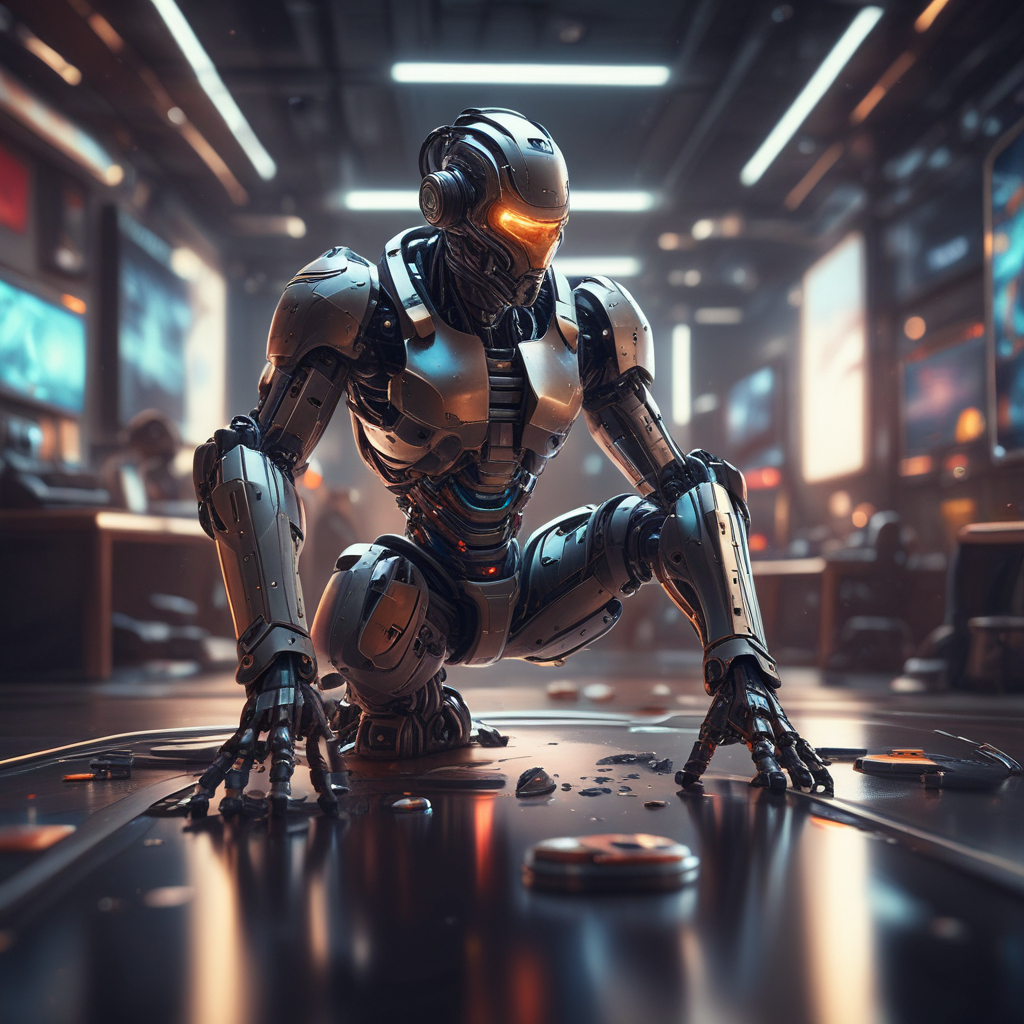
AI Redefines the Future of Gaming with Ray Tracing and Neural Rendering
The gaming industry is on the cusp of a visual revolution, driven by the rapid advancements in artificial intelligence (AI) technologies. Two key innovations - ray tracing and neural rendering - are poised to rewrite the rules of real-time graphics and immersion.
Ray Tracing Unlocks Cinematic Realism
Ray tracing, a rendering technique that simulates the natural behavior of light, has long been the holy grail of computer graphics. Traditionally, it has been computationally intensive, making it impractical for real-time gaming applications. However, the latest AI-powered ray tracing solutions from industry leaders like Nvidia are changing the game.
According to a recent study published in the Journal of Computer Graphics, ray tracing can now achieve up to a 40% reduction in rendering time compared to traditional rasterization techniques. This dramatic performance boost is made possible by AI-powered denoising algorithms that intelligently remove visual artifacts, allowing for fewer ray samples to be calculated without sacrificing image quality.
Neural Rendering Reimagines Virtual Worlds
Beyond ray tracing, neural rendering is another AI-driven breakthrough that is redefining the boundaries of game graphics. This technique leverages deep learning models to generate and enhance virtual environments, characters, and objects in real-time.
"Neural rendering allows us to create digital worlds that are indistinguishable from reality," says Dr. Sanja Fidler, a professor of computer science at the University of Toronto. "By combining AI-powered scene understanding with generative models, we can synthesize photorealistic assets that adapt dynamically to player interactions and changing game conditions."
The Path to Immersive Gaming Experiences
As ray tracing and neural rendering continue to mature, the gaming industry is poised for a visual renaissance. Developers can now craft environments that feel truly alive, with lighting, textures, and details that blur the line between the virtual and the physical.
"These AI-driven advances are unlocking a new era of immersive gaming experiences," says industry analyst Michael Park. "Players will be transported to worlds that feel tangible and alive, elevating the emotional connection to the gameplay. The future of gaming is here, and it's powered by the incredible capabilities of artificial intelligence."
References
-
Yixing Chen, Yiding Wang, Siqi Zhu et al. (2025). "Multi-Agent Evolve: LLM Self-Improve through Co-evolution." arxiv. [Link]
-
André Rocha, Claudia Manini, José I López et al. (2025). "Effect of intratumor heterogeneity in managing the go-or-grow dichotomy of cancer cells: a game theory modeling to understand metastasis." arxiv. [Link]
-
Siyuan Zheng, Pai Liu, Xi Chen et al. (2025). "BaZi-Based Character Simulation Benchmark: Evaluating AI on Temporal and Persona Reasoning." arxiv. [Link]