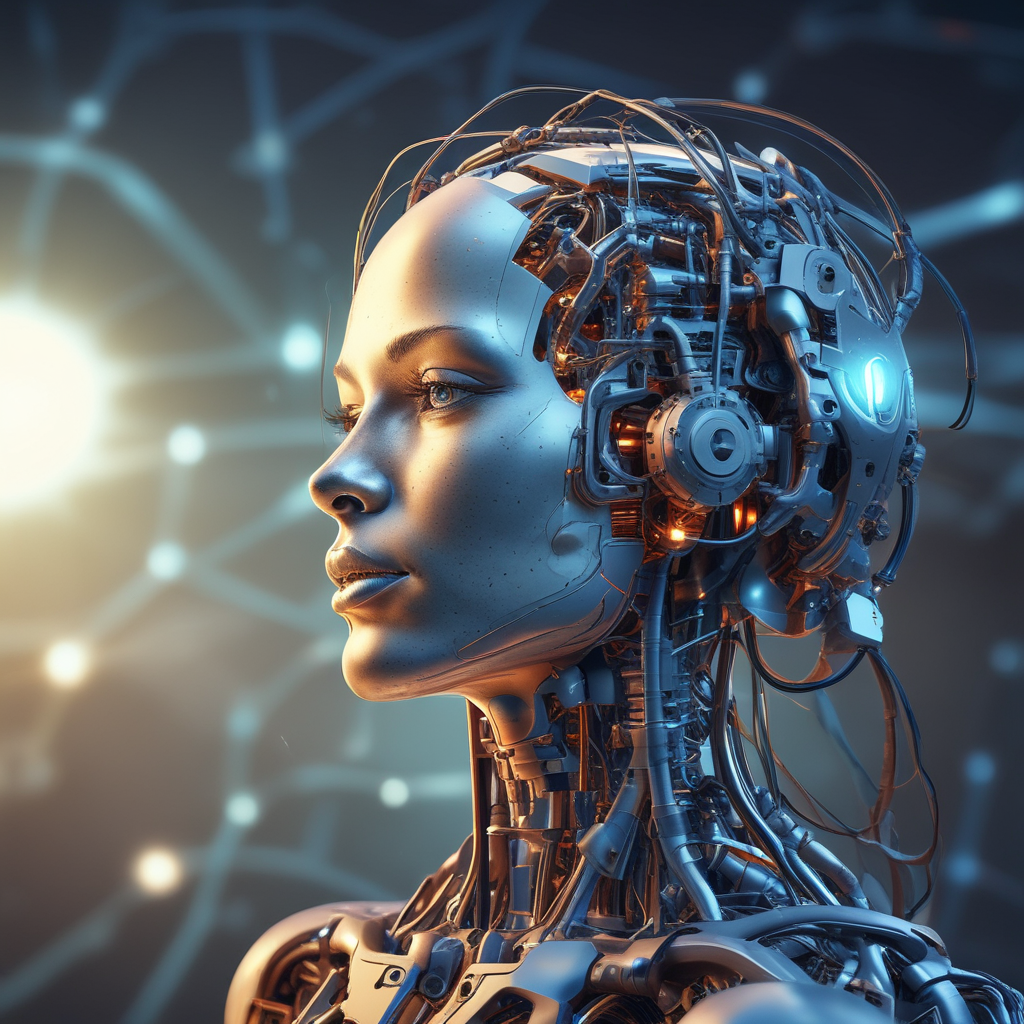
Breakthrough AI Models Accelerate Scientific Discovery
Recent advances in artificial intelligence are driving remarkable breakthroughs across the scientific landscape. Cutting-edge AI models are opening new frontiers in fields as diverse as materials science, astrophysics, and computational biology, empowering researchers to tackle complex challenges with unprecedented speed and precision.
At the forefront of this revolution are large language models (LLMs) - AI systems trained on vast troves of text data to develop powerful natural language understanding. These versatile models are proving invaluable tools for scientific inquiry, capable of distilling insights from sprawling research literature, generating novel hypotheses, and even designing custom experiments.
"LLMs have the remarkable ability to connect the dots in ways that would be nearly impossible for a human researcher," explains Dr. Jiyu Cui, lead author of a groundbreaking study on the application of LLMs to metal-organic framework (MOF) discovery. "By ingesting and comprehending huge volumes of technical information, these models can rapidly identify promising areas for exploration and devise innovative experiments to validate their ideas."
Cui's team developed L^2M^3OF, a specialized LLM trained on MOF-related data, and demonstrated its capacity to autonomously generate new MOF structures with desired properties. "This represents a major leap forward in the field of materials science," Cui notes. "Historically, MOF development has been a painstakingly slow process of trial-and-error. L^2M^3OF allows us to short-circuit that cycle, accelerating the discovery of novel MOFs with crucial applications in clean energy, carbon capture, and beyond."
Similar breakthroughs are unfolding across scientific disciplines. In astrophysics, a team led by Leonardo Ricca has leveraged multi-messenger data analysis - combining gravitational wave, neutrino, and electromagnetic observations - to study binary black hole systems near active galactic nuclei, shedding new light on these enigmatic cosmic phenomena. And in the realm of computational biology, the CAIA research consortium has pioneered the use of federated learning and intelligent software agents to drive collaborative cancer research, overcoming data privacy and access barriers.
"The common thread is the ability of these advanced AI models to synthesize vast amounts of information, generate novel ideas, and accelerate the scientific process," explains Dr. Matthias Vereecken, Ricca's collaborator. "Researchers are no longer constrained by the limits of human cognition - AI is augmenting and enhancing our capacity for discovery in ways that were unimaginable just a few years ago."
Of course, the responsible development and deployment of these powerful AI tools remains a critical challenge. Concerns around model bias, safety, and transparency must be rigorously addressed to ensure these breakthroughs serve the greater good. But the scientific community is rising to meet this challenge, leveraging AI's potential while upholding the highest standards of ethics and integrity.
"We are truly at the dawn of a new era of scientific exploration," Cui concludes. "By harnessing the transformative power of AI, we have the opportunity to unlock secrets of the universe, unravel the mysteries of life, and engineer solutions to humanity's greatest challenges. The breakthroughs we're witnessing today are just the beginning."
Key Takeaways
- Large language models are revolutionizing scientific research, enabling rapid hypothesis generation, experiment design, and knowledge synthesis
- Breakthroughs span diverse fields including materials science, astrophysics, and computational biology
- AI models can connect insights across vast datasets in ways human researchers cannot, accelerating the pace of discovery
- Responsible development and deployment of these powerful tools remains a critical challenge, requiring vigilance around ethics and transparency
 Breakthrough AI Models Accelerate Scientific Discovery - Key Takeaways
Key Takeaways
References
-
Yunhong Tao, Wenbing Tao, Xiang Xiang (2025). "Frequency-Spatial Interaction Driven Network for Low-Light Image Enhancement." arxiv. [Link]
-
Leonardo Ricca, Matthias Vereecken, Christoph Raab et al. (2025). "Multi-Messenger Search for Neutrino and Gravitational-Wave Emissions from Binary Black Holes Near Active Galactic Nuclei." arxiv. [Link]
-
Jiyu Cui, Fang Wu, Haokai Zhao et al. (2025). "L^2M^3OF: A Large Language Multimodal Model for Metal-Organic Frameworks." arxiv. [Link]
 Breakthrough AI Models Accelerate Scientific Discovery - References
References