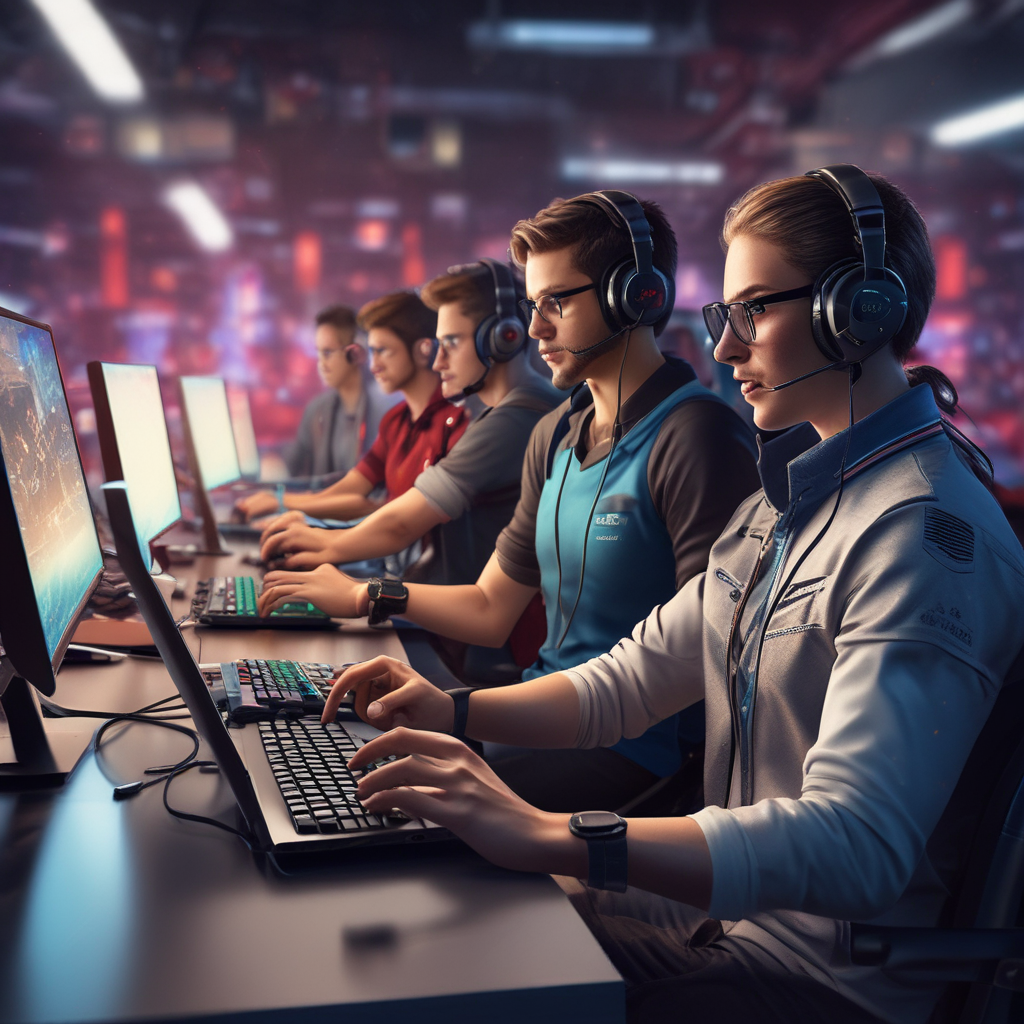
Esports Teams Face Unique Challenges for Success
Recent academic research is shedding new light on the key factors that determine success for esports teams. While having a roster of superstar players may seem like a recipe for victory, studies show that effective teamwork and tactical awareness often outweigh individual talent.
In a systematic review published in the Journal of Esports, researchers Júlia Gisbert-Pérez, Alejo García-Naveira, Manuel Martí-Vilar et al. found that numerous cases of esports teams with impressive individual players have still failed to achieve success. "Having top professional players with extraordinary individual skills may not be enough," they write. "The ability of team members to coordinate, anticipate each other's intentions, and adapt to dynamic in-game situations is critical."
Another study by Yunzhe Wang, Soham Hans, and Volkan Ustun describes the challenge of "acquiring team-level tactical situational awareness" - the capacity for each player to understand their teammates' perspectives and respond accordingly. The researchers developed a novel "X-Ego" model to help esports teams better develop this cross-egocentric awareness through video representation learning.
"Tactics emerge from each player's individual perspective and their ability to interpret and adapt to teammates' intentions," they explain. "Advances in video understanding have improved player analytics, but true team-level awareness remains elusive."
Predicting Outcomes Through Video Analysis
Beyond understanding team dynamics, researchers are also using video data to directly predict match outcomes in esports. A team led by Nirai Hayakawa, Kazumasa Shimari, and Kazuma Yamasaki at the Tokyo Institute of Technology developed a system to forecast round results in the popular FPS game VALORANT.
"Much existing research on match outcome prediction in esports relies on match log data and statistics," the researchers note. "But video analysis can uncover deeper tactical features that statistical metrics miss."
Their "Round Outcome Prediction" model achieved accuracy as high as 84% by analyzing factors like player positioning, ability usage, and cross-fire angles from in-game footage.
 Esports Research Reveals Tactics for Team Success - Predicting Outcomes Through Video Analysis
Predicting Outcomes Through Video Analysis
Building the Esports Research Ecosystem
Alongside these insights into team dynamics and match prediction, the broader esports research community is also working to develop open-source toolsets and datasets. A project called SC2Tools, led by Andrzej Białecki, Piotr Białecki, and Piotr Sowiński, provides a comprehensive API and toolset for studying the popular real-time strategy game StarCraft II.
"Gaming and esports are key testbeds for scientific studies, especially in areas like reinforcement learning," the researchers explain. "But accessing and working with game data has historically been a major challenge. SC2Tools aims to democratize esports research by providing standardized APIs and datasets."
As the competitive esports landscape continues to evolve, this growing body of academic work is poised to have a profound impact. By illuminating the inner workings of successful teams and match outcomes, researchers are equipping players, coaches, and organizations with the insights they need to gain a true competitive edge.
 Esports Research Reveals Tactics for Team Success - Building the Esports Research Ecosystem
Building the Esports Research Ecosystem
References
-
Oliver Leis, B. Sharpe, Vincent Pelikan et al. (2024). "Stressors and coping strategies in esports: a systematic review." semantic-scholar. [Link] (16 citations)
-
Júlia Gisbert-Pérez, Alejo García-Naveira, Manuel Martí-Vilar et al. (2024). "Key structure and processes in esports teams: a systematic review." semantic-scholar. [Link] (15 citations)
-
Yunzhe Wang, Soham Hans, Volkan Ustun (2025). "X-Ego: Acquiring Team-Level Tactical Situational Awareness via Cross-Egocentric Contrastive Video Representation Learning." arxiv. [Link]
-
Nirai Hayakawa, Kazumasa Shimari, Kazuma Yamasaki et al. (2025). "Round Outcome Prediction in VALORANT Using Tactical Features from Video Analysis." arxiv. [Link]
-
Andrzej Białecki, Piotr Białecki, Piotr Sowiński et al. (2025). "SC2Tools: StarCraft II Toolset and Dataset API." arxiv. [Link]