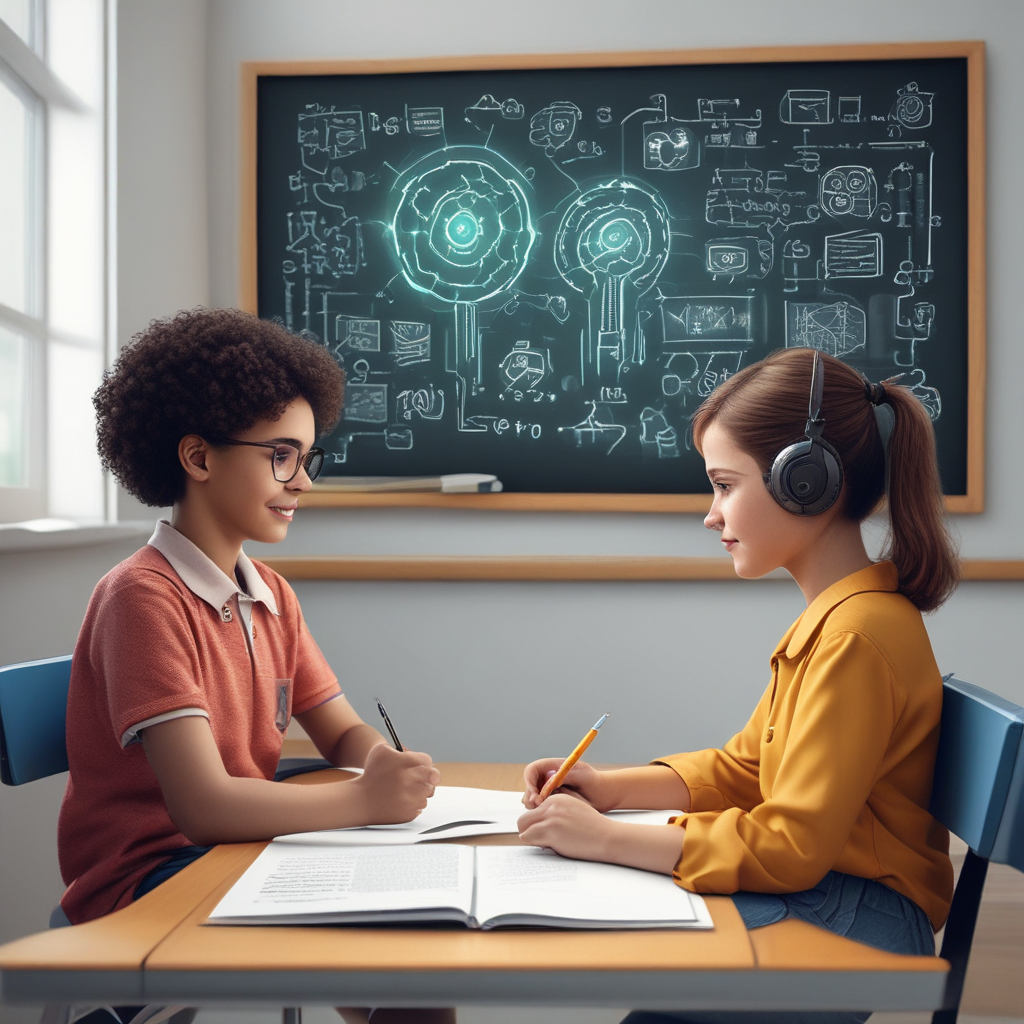
Unlocking the Potential of AI in Education
Recent advancements in artificial intelligence (AI) have opened up new frontiers for enhancing teaching and learning outcomes. Researchers and educators are exploring how AI-powered tools can personalize instruction, optimize curriculum, and empower students in unprecedented ways.
Personalized Learning Pathways
AI-based adaptive learning systems can analyze student performance data in real-time, identifying knowledge gaps and tailoring content to individual needs. By automating formative assessments and providing personalized feedback, these systems free up teachers to focus on higher-level instruction and coaching.
"AI is a game-changer for delivering truly personalized learning experiences," says Dr. Maya Sharma, an education technology researcher at the University of Toronto. "Students can progress at their own pace, with AI systems adjusting the difficulty and pace to keep them engaged and challenged."
 How AI is Transforming Education Outcomes - Personalized Learning Pathways
Personalized Learning Pathways
Intelligent Tutoring and Content Generation
Large language models (LLMs) like GPT-4 have demonstrated the ability to generate human-like text, code, and multimedia content. Educators are now experimenting with using these AI assistants as intelligent tutors, able to provide customized explanations, examples, and feedback.
"With AI tutors, we can scale high-quality instruction to reach more students, especially in underserved communities," explains Anita Bose, director of digital learning at the nonprofit EdTech organization Acme. "The technology is still nascent, but the early results are very promising."
Powering Adaptive Curriculum and Assessment
AI algorithms can also help educators optimize their curriculum and assessment strategies. By analyzing student learning data, AI systems can identify content gaps, suggest remedial activities, and even generate personalized exams.
"AI gives us the ability to continuously refine our curriculum based on real student outcomes," says Dr. Jian Liu, an instructional design professor at MIT. "Instead of a one-size-fits-all approach, we can dynamically adapt lessons and assessments to maximize engagement and learning."
 How AI is Transforming Education Outcomes - Powering Adaptive Curriculum and Assessment
Powering Adaptive Curriculum and Assessment
Ethical Considerations and Responsible Implementation
As the use of AI in education expands, experts caution that implementation must be done thoughtfully and with strong safeguards. Issues around data privacy, algorithmic bias, and student privacy must be carefully addressed.
"AI holds immense potential, but we have to make sure it's deployed responsibly and equitably," warns Dr. Samantha Blackmon, an education policy researcher at Stanford University. "Transparent, collaborative processes involving all stakeholders will be critical to realizing AI's benefits while mitigating potential harms."
Overall, the confluence of AI and education is an exciting frontier, with the possibility to transform how students learn and teachers instruct. By embracing these technologies responsibly, the education community can unlock new frontiers of personalized, adaptive, and data-driven instruction.
References
-
Yizhang Zhu, Liangwei Wang, Chenyu Yang et al. (2025). "A Survey of Data Agents: Emerging Paradigm or Overstated Hype?." arxiv. [Link]
-
Joachim Baumann, Aleksandra Urman, Ulrich Leicht-Deobald et al. (2025). "Reduced AI Acceptance After the Generative AI Boom: Evidence From a Two-Wave Survey Study." arxiv. [Link]
-
KC Santosh, Rodrigue Rizk, Longwei Wang (2025). "Toward Carbon-Neutral Human AI: Rethinking Data, Computation, and Learning Paradigms for Sustainable Intelligence." arxiv. [Link]
-
Gordon M, Daniel M, Ajiboye A et al. (2024). "A scoping review of artificial intelligence in medical education: BEME Guide No. 84.." pubmed. [Link]
-
Boscardin CK, Gin B, Golde PB et al. (2024). "ChatGPT and Generative Artificial Intelligence for Medical Education: Potential Impact and Opportunity.." pubmed. [Link]