
How to Calculate ROI on AI Tools for Small Business: A Practical 2026 Playbook
If you own or run a small business and you're staring at a $30/month AI subscription wondering whether it's actually paying for itself, this piece is for you. By the end, you'll have a repeatable way to calculate ROI on AI tools for small business — one that survives contact with reality in month two, when the honeymoon ends and someone on your team quietly stops using the thing. No spreadsheets from a Fortune 500 finance team. Just a method a 15-person shop can run on a Tuesday afternoon.1
Set the baseline before you buy anything
You cannot measure a lift you never established a floor for. Before the free trial starts, write down three numbers: hours spent per week on the task, dollar cost of those hours (loaded, not just wage), and a quality proxy (customer response time, invoice error rate, leads qualified per week — pick one).
Do this for two weeks minimum. If your customer service rep spends 12 hours a week on repetitive email triage at a loaded cost of $35/hour, your baseline is $420/week or roughly $21,800/year on that one task. That number is what any AI tool has to beat, net of its subscription and your time setting it up.
Here's a minimal baseline-tracking template you can drop into any spreadsheet. Columns A–E hold the inputs; column F does the math:
A: Task            B: Hours/wk   C: Loaded $/hr   D: Weeks/yr   E: Quality proxy    F: Annual cost
Email triage       12            35               50            Avg response: 8h    =B2*C2*D2
Invoice entry      6             40               50            Error rate: 4%      =B3*C3*D3
Lead qualifying    8             45               50            Qualified/wk: 12    =B4*C4*D4
Skip this step and you run into the problem SmartDev's Dieu Anh Nguyen describes in her April 2025 piece: AI gains overlap with other business changes, so without a baseline you cannot isolate what the tool did. It becomes vibes-based budgeting.
The five-step ROI calculation
 Establishing baseline metrics before AI tool investment enables accurate ROI calculation for small business success.
Here's the sequence. Run it per tool, not for "AI" as a category — whether it's a customer service chatbot, a marketing automation AI, or a generative AI writing assistant plugged into your customer relationship management system.
Step 1: Total 12-month cost. Subscription × 12, plus onboarding hours × loaded rate, plus any integration fees. A $25/month tool isn't $300/year if it took someone 20 hours at $50/hour to set up — it's $1,300. In a spreadsheet: =(monthly_sub*12) + (setup_hours*loaded_rate) + integration_fees.
Step 2: Measurable time saved per week. After the learning curve (more on that in a second), re-measure the same task you baselined. Multiply the delta by 50 working weeks and the loaded hourly cost: =(baseline_hrs - new_hrs) * 50 * loaded_rate.
Step 3: Revenue impact, if any. Marketing and sales tools can move top-line numbers. Agency roundups — one Milwaukee web design firm headlines "85% see returns in the first year" — report outsized gains for marketing automation adopters. Those pages are selling AI services. Treat their numbers as ceiling scenarios, not expectations. Measure your own lead volume before and after.
Step 4: Subtract cost from benefit, divide by cost. ROI % = (Annual Benefit − Annual Cost) / Annual Cost × 100. A tool that saves you $8,000 and costs $1,300 is running at roughly 515% ROI. That's the number to put in front of yourself when renewal comes up.
Step 5: Sanity-check against a benchmark. Nucleus Research's widely cited figure for marketing automation is roughly $5.44 returned per dollar spent. Chatbot vendors typically claim ticket deflection in the 30% range for well-scoped deployments; treat that as a vendor number. If your math shows 4,000% ROI, you've either found gold or you're double-counting. Usually the latter.
The month-two problem nobody warns you about
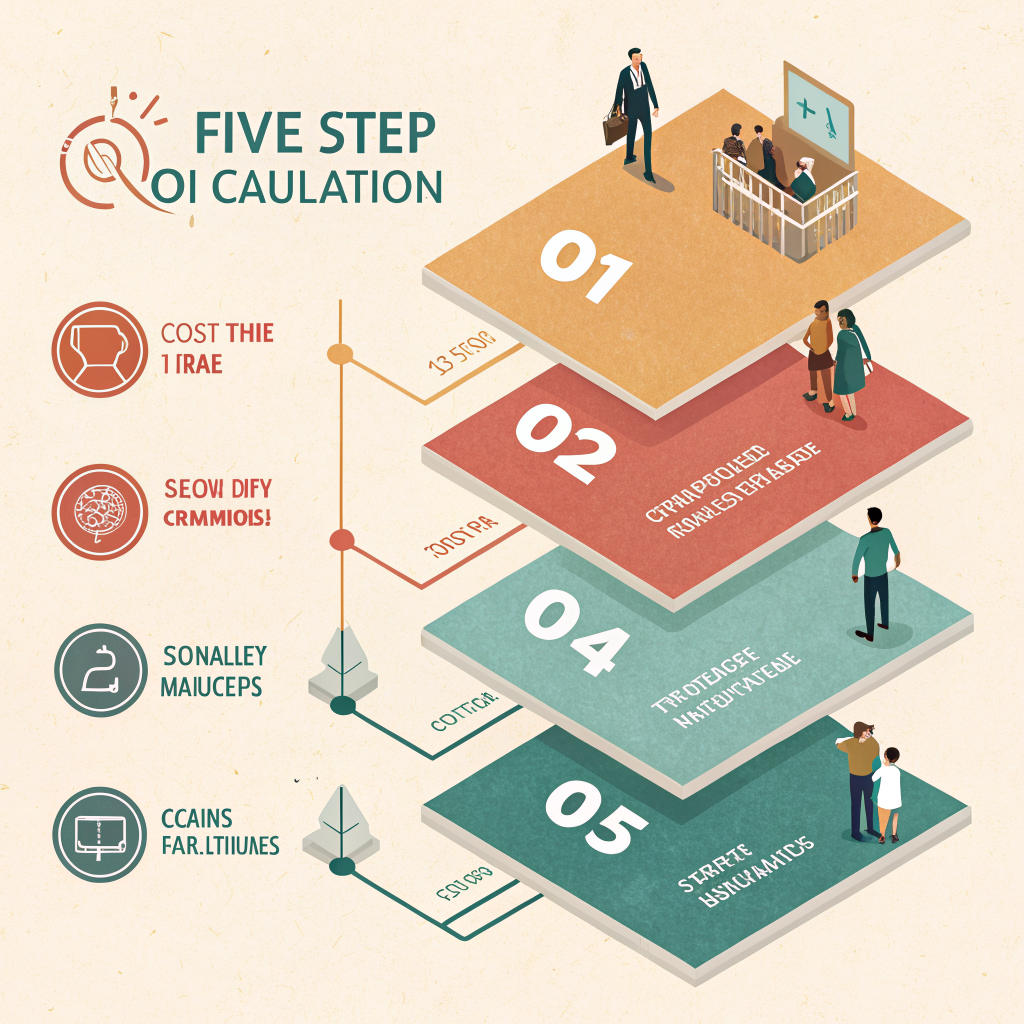 Five-step framework for calculating AI ROI on small business investments and measuring tool effectiveness.
The single biggest mistake in AI ROI calculation for small business is measuring too early. DX's research is explicit: allow a 3–6 month learning curve before drawing conclusions. Measuring AI tool effectiveness before your team has learned to use it strategically produces misleading results — usually pessimistic ones, because week one is all fumbling.
So run two checkpoints. At day 30, only measure adoption: are people actually using it? If your bookkeeper opened the invoicing AI twice and went back to manual entry in her enterprise resource planning tool, you don't have a tool problem, you have a training problem. Fix that before you calculate anything.
At day 90, measure productivity and quality. That's when the numbers get honest.
What to measure at each checkpoint
| Checkpoint | Metric | Target | How to measure | Warning sign |
|---|---|---|---|---|
| Day 30 | Monthly active users | 93%+ of eligible staff (DX developer-tool benchmark; treat as directional for other roles) | Pull from the tool's admin dashboard (usage/analytics tab) or export seat activity CSV | <75% adoption |
| Day 30 | Weekly active users | 74%+ | Same admin dashboard, filter by 7-day window | <50% adoption |
| Day 90 | Hours saved per user per week | 3+ hours | Compare re-measured task time to your baseline sheet | <1 hour |
| Day 90 | Quality proxy | Improved vs. baseline | Rerun the same metric you captured pre-trial (errors, response time) | Flat or worse |
| Day 180 | Net annual ROI | Beats baseline cost by 2x+ | Plug into the Step 4 formula above | Below tool cost |
The 3-hour benchmark isn't arbitrary. DX found developers save an average of 3.9 hours per week with AI tools, and daily users merge 60% more PRs than non-users. That's a software-engineering finding — whether it maps to your ops or marketing staff is an open question, but the underlying pattern (heavy users get the payback, dabblers don't) is worth stress-testing on your own team.
Pick the right tool to measure in the first place
Nada Sanders, a Northeastern University professor, put it well in Phil Goldstein's June 2025 BizTech Magazine roundtable: small businesses should prioritize AI that integrates into existing workflows — customer service, marketing, operations — rather than chasing emerging tech. That's also where the ROI math works cleanest, because those tasks already have baseline metrics attached to them. If your books and customer records already live in mainstream tools, adding automation for customer service on top of that stack is a shorter path to measurable ROI than standing up something novel.
One encouraging data point to close on: per the JPMorgan Chase Institute's 2025 report on small business AI use, typical monthly AI-related software spend for small businesses has come down meaningfully from the 2019 baseline the Institute originally tracked — putting most useful tools within reach of a 15-person shop. The tools got cheaper. The measurement discipline is still what separates the shops that get their money back from the ones that don't.
Run the five steps. Wait the 90 days. Kill what doesn't clear the bar, and double down on what does.
Sources
- getdx.com – "How to measure AI performance in software engineering - DX" (2026)
- jpmorganchase.com – "Understanding the use of AI among small businesses" (2026)
- milwaukee-webdesigner.com – "AI ROI Small Business: Maximize Returns in 2025 • Milwaukee Web Design®" (2026)
- biztechmagazine.com – "How Small Businesses Can Capitalize on Their Artificial Intelligence Opportunities | BizTech Magazine" (2026)
- smartdev.com – "AI ROI: How to Measure and Maximize Your Return on Investment in Artificial Intelligence | SmartDev" (2026)
Footnotes
-
Fair warning on benchmarks: most AI ROI math you see online is oversold. Vendor case studies quote 10x returns; the DX benchmark shows most organizations get only 5–15% gains in PR throughput despite industry-wide AI tool adoption reaching 93%. Both can be true. Your job is to figure out which end of that range you're on. ↩